> ## Documentation Index
> Fetch the complete documentation index at: https://nayax-44d6e37b-docs-marshall-faq-redistribution.mintlify.site/llms.txt
> Use this file to discover all available pages before exploring further.
# Nayax Core Operations
> Retrieve device logs, manage the product map, and request refunds from Nayax Core
Part of a Marshall integration happens in Nayax Core rather than in the SDK.
The two device-side logs, the product map, and refunds all live there.
## Retrieve a Gtrace
A Gtrace records what the device itself is doing, which makes it the counterpart
to the SDK log: the SDK log only covers traffic between the device and your
peripheral.
Gtrace is a log that records general device behavior. The Nayax reader
generates it and sends it to Nayax Core, so it is separate from the SDK logs
and never appears in the SDK's command output.
To retrieve a Gtrace, open the relevant machine in Nayax Core and follow these
steps.
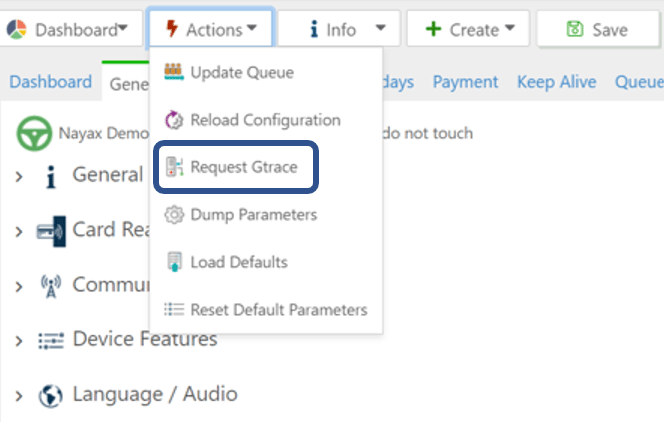
Go to **Actions** > **Request Gtrace**.
 Once the request is sent, one or more new rows appear in the table under
the **Dex** tab, with a Dex Source of `GtraceV2`.
Once the request is sent, one or more new rows appear in the table under
the **Dex** tab, with a Dex Source of `GtraceV2`.
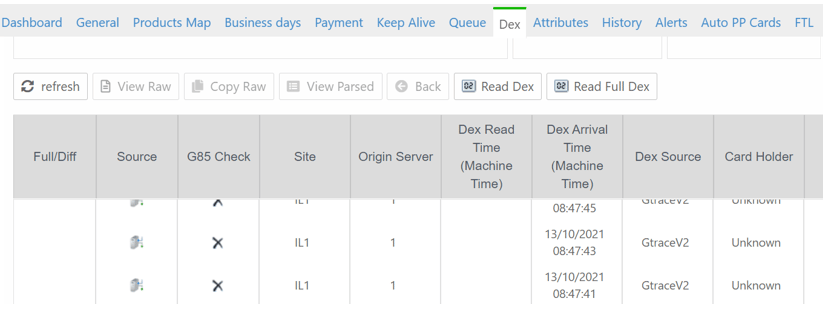 Select the row for the log you want, then select **View Parsed** to read
the full log.
**The device must be online.** Nayax Core can only collect a Gtrace from a
device that is powered on and connected.
## Retrieve Last Alerts
Last Alerts holds both the alerts the device raises on its own and the alerts
your integration sends with the `alert` method, documented in
[General Marshall Events](/docs/integrate-pos-device/marshall/methods-functions/general-marshall-events).
Last Alerts is a log in Nayax Core that records the alerts exchanged between
the device and the Nayax servers. It sits under the device's virtual machine.
To read it, open the relevant virtual machine and go to **Info** >
**Last Alerts**.
Select the row for the log you want, then select **View Parsed** to read
the full log.
**The device must be online.** Nayax Core can only collect a Gtrace from a
device that is powered on and connected.
## Retrieve Last Alerts
Last Alerts holds both the alerts the device raises on its own and the alerts
your integration sends with the `alert` method, documented in
[General Marshall Events](/docs/integrate-pos-device/marshall/methods-functions/general-marshall-events).
Last Alerts is a log in Nayax Core that records the alerts exchanged between
the device and the Nayax servers. It sits under the device's virtual machine.
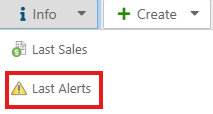
To read it, open the relevant virtual machine and go to **Info** >
**Last Alerts**.
 ## Manage the Product Map
Marshall does not read the product map during a transaction. The product code
your peripheral sends drives the flow, and the price comes from the Vend
Request rather than from the map. The only field that matters to you is the
product name, which is what turns an `unknown` product in Last Sales or in an
eReceipt into a readable name.
The product map lets you manage the products assigned to your peripherals from
Nayax Core. Each row maps a product code to a product name and cost, and that
name is what appears in Last Sales, the Dynamic Transaction Monitor, and the
eReceipt file.
To add a product, open the **Product Map** tab, go to **Map** > **Add BIN**,
then enter the product code, product group, PA code, and MDB code. The MDB code
is the one that must match the product code your integration sends. Select
**Save** to store the row.
### Example
The peripheral sends a Vend Request for product code `1` with a price of
`10.00`. The product map has a row for product code `1` named `Apple` with a
cost of `20.00`.
The consumer is charged `10.00`, the price from the Vend Request. In Last Sales
and the Dynamic Transaction Monitor, the transaction shows product code `1`
alongside the name `Apple`.
Nayax U has step-by-step guides for the product map itself:
* [Create a product map template](https://nayax-u.nayax.com/scenario/how-to-create-a-product-map-template-administration-2349)
* [Create a product in the product map](https://nayax-u.nayax.com/scenario/how-to-create-a-product-administration-937)
## Request a Refund
Marshall has no refund feature of its own, because a refund concerns the
payment rather than the communication between your machine and the device.
Refunds run through Nayax Core.
A refund returns money to a consumer for a transaction that has already
completed and settled.
To request one, go to the **Dynamic Transactions Monitor** page in Nayax Core,
right-click the relevant transaction, select **Request refund**, and confirm.
The Nayax team reviews the request. Once it is approved, the funds return to
the account within 1 to 2 days.
If you have not charged the consumer yet, you do not need a refund. Respond
with Vend Failure, or close the session with a status other than `Status Ok`.
See [Create Payments](/docs/integrate-pos-device/marshall/marshall-create-payments).
## Next steps
Turn on SDK logging and find the log file that records peripheral traffic.
Set up and manage cashless payment transactions from your controller.
## Manage the Product Map
Marshall does not read the product map during a transaction. The product code
your peripheral sends drives the flow, and the price comes from the Vend
Request rather than from the map. The only field that matters to you is the
product name, which is what turns an `unknown` product in Last Sales or in an
eReceipt into a readable name.
The product map lets you manage the products assigned to your peripherals from
Nayax Core. Each row maps a product code to a product name and cost, and that
name is what appears in Last Sales, the Dynamic Transaction Monitor, and the
eReceipt file.
To add a product, open the **Product Map** tab, go to **Map** > **Add BIN**,
then enter the product code, product group, PA code, and MDB code. The MDB code
is the one that must match the product code your integration sends. Select
**Save** to store the row.
### Example
The peripheral sends a Vend Request for product code `1` with a price of
`10.00`. The product map has a row for product code `1` named `Apple` with a
cost of `20.00`.
The consumer is charged `10.00`, the price from the Vend Request. In Last Sales
and the Dynamic Transaction Monitor, the transaction shows product code `1`
alongside the name `Apple`.
Nayax U has step-by-step guides for the product map itself:
* [Create a product map template](https://nayax-u.nayax.com/scenario/how-to-create-a-product-map-template-administration-2349)
* [Create a product in the product map](https://nayax-u.nayax.com/scenario/how-to-create-a-product-administration-937)
## Request a Refund
Marshall has no refund feature of its own, because a refund concerns the
payment rather than the communication between your machine and the device.
Refunds run through Nayax Core.
A refund returns money to a consumer for a transaction that has already
completed and settled.
To request one, go to the **Dynamic Transactions Monitor** page in Nayax Core,
right-click the relevant transaction, select **Request refund**, and confirm.
The Nayax team reviews the request. Once it is approved, the funds return to
the account within 1 to 2 days.
If you have not charged the consumer yet, you do not need a refund. Respond
with Vend Failure, or close the session with a status other than `Status Ok`.
See [Create Payments](/docs/integrate-pos-device/marshall/marshall-create-payments).
## Next steps
Turn on SDK logging and find the log file that records peripheral traffic.
Set up and manage cashless payment transactions from your controller.